

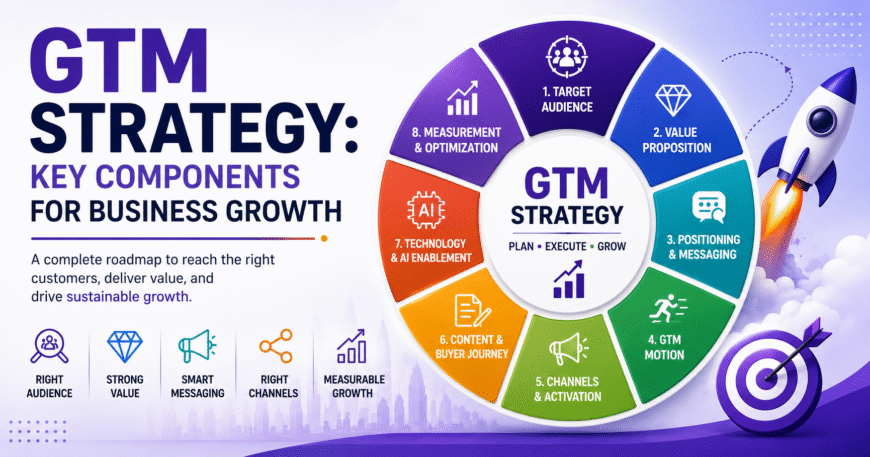
Product or service introduction is just the start of building an enterprise that works. A company may have a good product but will struggle to sell it if it does not know its audience well enough and how it will sell to it.
This is where the concept of go-to-market strategy, also known as GTM strategy, comes into play.
The definition of a go-to-market strategy is the systematic way of getting the product or service to the desired audience using proper positioning, channels, messaging, sales process, and experience.
Nowadays, B2B companies see go-to-market strategies not as a marketing effort but as a framework for generating revenues. The importance of go-to-market strategies becomes crucial in 2026 due to AI, behavioral changes, cross-functional teams, and requirement of ROI.
What Is a GTM Strategy?
GTM strategy is a type of strategy that describes how an organization will market its product or service in the chosen market.
The following key questions are addressed by the strategy:
- What is the target consumer?
- What problem will be solved?
- Why should people choose the product?
- How to reach them?
- Which channels to use?
- Which sales or marketing motion will be effective?
- What measures will be taken to determine success?
The effective strategy connects all those questions instead of considering them as distinct marketing actions.
1. Define Your Ideal Customer Profile
One of the critical elements of a GTM strategy is choosing the right audience.
Firms need to know:
- Industry
- Company Size
- Location
- Business Needs
- Purchasing Behavior
- Budget
- Decision-Makers
- Customer Needs
In the case of B2B companies, it may also include different stakeholders involved in the purchasing decision, for example, business owners, marketing managers, technology groups, and finance decision-makers.
Failure to choose an audience results in wastage of marketing efforts and resources.
2. Build a Clear Value Proposition
Once you have established your target audience, state the importance of your product/service to your target audience.
Good value propositions include:
Problem -> Solution -> Benefit -> Differentiation
Instead of stating something like:
“we offer digital marketing services”
It would be better to state what problem is being solved for the client and what they will gain from that solution.
Proper positioning ensures consistency of marketing efforts.
3. Develop Strong Positioning and Messaging
Positioning helps to define how the brand will be positioned in the marketplace.
The messaging must address why:
This product?
This company?
Now?
This needs to remain consistent across the following:
- Website
- Social media
- Advertising
- Sales presentations
- Email marketing
- Content marketing
- Landing pages
Marketing and sales teams with completely different messages send mixed signals to the customer.
4. Choose the Right GTM Motion
GTM approach is all about how your company connects with and convinces your customers.
Some GTMs that are used by companies are:
Sales-GTM
Your company’s sales team identifies the prospect, engages with him, demonstrates the product to him, and converts him into a customer.
Product-GTM
The product becomes an integral component of customer acquisition process. Free trial, demo, freemium or self-service may lead your customer towards discovering the product.
Marketing-GTM
Marketing efforts such as content, SEO, ads, social media, webinars etc., create demand and awareness about your product.
Mixed-GTM
Some companies use mixed strategies according to their products and customers.
Your decision depends upon the type of your product, customer experience, pricing, and sales cycle.
5. Select Your Marketing Channels
Yet another important element in the components of a GTM strategy is channel selection.
The following are the possible channels that you may consider using for GTM purposes:
- Search engine optimization
- Google ads
- Social media
- Email marketing
- Content marketing
- Partnerships
- Affiliate marketing
- Events
- Outreach sales
- Account based marketing
Do not attempt to utilize all channels simultaneously.
Rather select channels where you can realistically compete.
6. Create Content Around the Buyer Journey
Today’s consumers may do some product research before initiating contact with the sales team.
Therefore, content is a vital element of a B2B GTM approach.
Content creation should be done for various phases:
Awareness:
Educational blogs, guides, videos, and industry insights.
Consideration:
Comparison posts, case studies, webinars, and in-depth service pages.
Decision:
Price info, demos, reviews/testimonials, FAQs, and consultation pages.
7. Use AI Strategically
AI is being increasingly embedded into GTM process in modern times. The current conversation around B2B GTM involves the use of AI for research, customer signals, content, lead routing, and revenue operations.
But then AI has to be used for strategy purposes and not as a substitute for customer knowledge.
Firms could use AI for:
- Customer Data Analysis
- Prospect Research
- Pattern Identification
- Content Personalization
- Campaign Planning Assistance
- Automation of Repetitive Tasks
- Lead Qualification
The critical thing here is making a connection between these tools and the business objective.
8. Align Marketing and Sales
A GTM strategy is significantly enhanced when there is alignment between the marketing and sales teams in terms of their objectives.
The following should be aligned:
- Target customer profile
- Definition of leads
- Message to market
- Campaign objective
- Qualification of leads
- Follow-up strategy
- Revenue goal
This ensures that marketing does not concentrate only on traffic while the sales team only on closing deals.
9. Track GTM Performance
There must be objectives for any GTM strategy.
This varies by organization and includes:
- Web traffic
- Quality leads
- Conversion ratio
- Customer acquisition cost
- Sales pipeline
- Revenues
- Retention
- Campaign return on investment
Rather than asking “How many leads have we generated?”, consider asking:
“How many qualified opportunities and customers did our GTM activities generate?”
This makes the strategy more focused on business outcomes.
10. Continuously Optimize Your GTM Strategy
The GTM strategy should not stay constant once launched.
Regular review of results will reveal:
- What channel brings good leads?
- What communication works best?
- Where do customers drop out?
- What campaign generates income?
- What type of customers converts better?
- Where does automation/AI add value?
It forms a loop:
Strategy → Launch → Measurement → Learning → Optimization → Scaling
Not only is a good GTM strategy much more than just a checklist of product launches, but it also helps to align your ideal customer, positioning, message, channels, sales motion, content, technology, and measurement into one unified growth system.
It is crucial in 2026 as the more knowledgeable buyers will become, and the more AI technologies will be used in B2B companies’ research and decision-making processes, the more necessary this strategy will be.
Good GTM strategies are not always those with many channels and technologies used. Good GTM strategies are those who know their audience, have a strong value proposition, select the best GTM motion, and constantly measure the growth factors.
For those businesses seeking to create sustainable demand, GTM strategy development will help to coordinate marketing activities and measure success in terms of revenue generation.
