

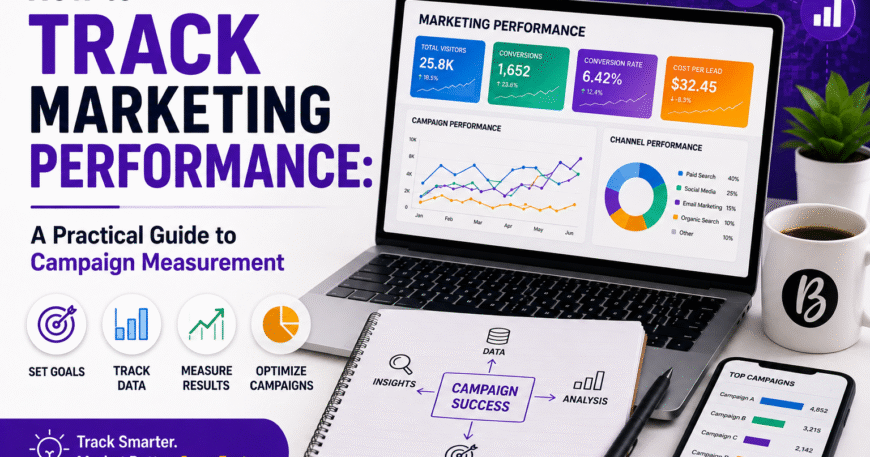
Launching marketing campaigns without measuring the performance of those campaigns is similar to driving without knowing one’s destination. This is because, without proper information, the effort put into generating traffic, clicks and more can only yield limited results for a business.
Measuring the performance of marketing can help businesses find out what channels bring them traffic, leads, conversions and revenue. They will find it easy to determine which marketing campaigns are not performing and where to channel the marketing budget in the coming months.
It doesn’t matter whether it’s Google Ads, social media campaigns, SEO or any other form of digital campaigns; marketing campaign performance measurement will help in decision making.
1. Start With Clear Marketing Goals
Define your objectives before starting performance tracking.
Depending on your business type, your objectives might include the following:
- Website visits
- Awareness
- Leads
- Product sales
- App installations
- Phone calls
- Form completions
- Bookings
- Income
For instance, B2B companies tend to concentrate on quality leads, while ecommerce websites tend to emphasize purchases and income.
As you see, your tracking mechanism should be aligned with your objectives, not just like or impression counts.
2. Identify the Right Performance Metrics
All marketing indicators do not have equal value.
Some of the most effective indicators used for performance marketing measurement are:
- Impressions
- Click through rate
- Cost per click
- Conversion rate
- Cost per lead
- Cost per acquisition
- Return on ad spend
- Revenue
- Customer acquisition cost
It all depends on what you wish to achieve with your campaign.
For instance, a campaign bringing thousands of clicks, yet no leads at all, may seem quite effective at first sight, however, it is not.
3. Track Every Marketing Channel Separately
It is common for many organizations to use multiple methods of advertising and marketing simultaneously.
These might be:
- Google Ads
- Meta Ads
- SEO
- Social media
- Email marketing
- Affiliate marketing
- Content marketing
Channelmarketing performance tracking in advertising helps you evaluate these different channels and see which of them works best.
For instance, one might get leads immediately from Google Ads, while SEO might require time to deliver constant organic traffic.
4. Use UTM Parameters for Campaign Tracking
The usage of UTM parameters is helpful in determining the source of traffic on a website.
The following pieces of information could be included:
- Source of campaign
- Medium
- Name of campaign
- Content
- Keyword or term
As an illustration, the use of a campaign URL can help determine if the visitor is coming from a particular Instagram campaign, email campaign, or advertisement.
5. Track Conversions, Not Just Traffic
Traffic to your site is crucial, but traffic alone doesn’t necessarily equate to income.
Companies need to identify conversion actions that have meaning.
Some of those might be:
Form start > Phone call > Consultation > Purchase > Income
For lead generation sites, measuring form starts, form submissions, phone calls, and inquiries will give you much more valuable data than mere page views.
It’s especially important for assessing performance marketing services, as the goal needs to be business results, not just web traffic.
6. Measure the Customer Journey
Very few clients will buy after coming into contact with your message once.
They may have:
- Found you via social media.
- Searched for your business on Google.
- Visited a blog.
- Checked out a service page.
- Clicked on an ad.
- Filled out a form.
Customer journey analysis becomes a must-have here.
Rather than focusing on the last click alone, companies need to see the value of various channels during their customers’ journeys.
It can give more insights into digital marketing performance monitoring and prevent the focus on one channel.
7. Monitor Cost and Return
If you’re spending your money on advertising, then cost-based measurements are vital.
For instance:
Cost Per Lead = Campaign Spending / Number of Leads
And:
ROAS = Sales / Campaign Budget
Such measurements might help to know if campaigns are financially viable.
The campaign, which is cost-efficient per click, is not necessarily effective if it delivers low quality leads.
The key question should be:
“How much business value did this campaign deliver?”
8. Compare Campaign Performance
Frequent comparisons will make spotting trends much easier.
One can compare:
- Campaign A and Campaign B
- Google Ads and Meta Ads
- Organic and Paid Traffic
- New and Returning Visitors
- Various landing pages
- Various audiences
- Various ad creatives
This way, marketing specialists will be able to learn which strategies work and which need to be optimized.
For instance, in the case when Campaign A has a high click-through rate, but Campaign B has many more qualified leads, the latter is more valuable for the business.
9. Use Content Performance Data
The content marketing process should also be quantified.
Measure:
- Organic views
- Organic clicks
- Average rank
- Engagement
- Scroll behavior
- Internal link clicks
- Lead generation
- Conversions
Blogs that attract people yet cannot generate engagement can definitely improve.
At the same time, articles that have few visits but many leads are definitely worth more.
This is the reason that measurement of marketing performance must take into account quality and outcomes instead of traffic numbers.
10. Create a Regular marketing performance tracking
The process of analyzing marketing data is more effective if done periodically.
This can be simply achieved by the following report:
Traffic -> Engagement -> Leads -> Conversions -> Revenue
Channel-level marketing performance tracking can also be included in the analysis to determine what marketing activities need improvements.
Periodic monitoring of marketing performances will help businesses to detect problems early before the end of the marketing campaigns.
How to Improve Marketing Performance
Data tracking is just the start. Next comes optimization.
A campaign that is underperforming in terms of conversions should have its landing page tested.
An ad that has a poor CTR should be followed up with testing new messaging.
Organic traffic is growing but leads are not, then conversion rate optimization is required.
One advertising platform continues producing better leads? Allocate more budget there.
It’s a continuous loop of:
Track → Analyze → Optimize → Test → Measure Again
marketing performance tracking should not be about keeping tabs on all the numbers available; rather, it is about finding out which metrics tie your marketing efforts to real business outcomes.
With the application of systematic marketing performance monitoring, advertising channel monitoring, conversion tracking, customer journey analysis, and review of results, your business will be in a better position to make effective marketing decisions.
In summary, the essence of marketing performance measurement lies in understanding which strategies work and which don’t and using this information to improve your marketing effectiveness.
