

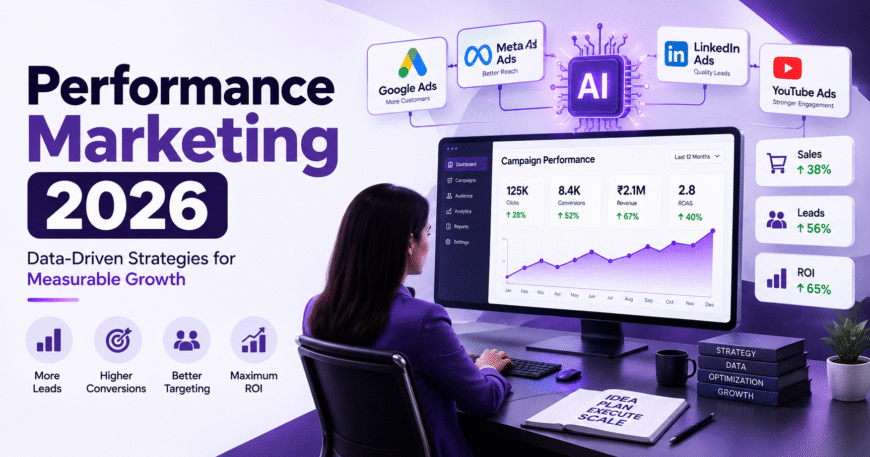
However, digital advertising is evolving rapidly. Search algorithms, artificial intelligence for advertising, automated bidding, audience signals, and privacy issues will all play a role in shaping the planning and measurement of performance marketing campaigns in the coming years.
Running ad campaigns in 2026 will not be simply about generating clicks anymore. Companies will have to identify which users are converting, which products bring income, which channels work the best and the influence that AI is having on optimizing the campaign.
This will prove beneficial for brands investing in performance marketing services.
What Is Changing in Performance Marketing in 2026?
Traditionally, performance marketing is based on measurable activities such as clicks, leads, purchases, sign-ups, sales, etc.
Nowadays, advertising platforms rely on machine learning for the automation of decisions related to:
- Audience segmentation
- Bidding
- Placement
- Creative optimization
- Budget allocation
- Conversions
- Customer acquisition
In other words, advertisers are shifting from the manual control of all parameters of their campaigns towards more accurate data, creative resources, conversions, and objectives.
1. AI Is Becoming Part of Campaign Optimization
AI has become an inseparable part of large advertising platforms.
Instead of testing each combination of audience and bids separately, algorithms can work with huge amounts of data and optimize campaigns based on conversion messages.
That means for performance advertisers, it becomes another important task to do:
Better input data -> Better optimization -> Better decision-making
And that is why companies should ensure that their conversion tracking is properly set up before investing additional money into advertising.
2. Conversion Tracking Is More Important Than Ever
Clicks can tell you that there was interaction with the ad, but clicks do not necessarily tell you if there was a business created through the campaign.
Performance measurement in marketing is measured by actions like:
- Forms
- Phone calls
- Sales
- Leads
- Sign-ups
- Revenue
- Repurchase
- Cost per acquisition
For instance, assume that Campaign A produces 1,000 clicks but five leads, while Campaign B produces 500 clicks but 20 leads.
Campaign B may have more value than Campaign A despite getting less clicks.
3. Businesses Are Focusing More on First-Party Data
The shifting landscape and limited availability of certain signals used traditionally for tracking purposes are increasing the importance of first-party data.
Companies can leverage data that is available about customers through:
- CRM data
- Website conversions
- Customer purchases
- Email subscribers
- Lead quality
- Returning customers
Data like this could help companies see which ad campaigns are creating high-quality customers.
4. Creative Testing Is Becoming a Performance Strategy
Performance marketing is not only about targeting and bidding anymore.
The quality of the creative can impact the performance of the campaign greatly.
Instead of designing just one ad to be run over the course of several months, marketers need to try out different combinations of:
Hook + Message + Visual + Offer + Call-to-Action
For instance:
“Need more leads?”
can be compared with:
“Lower your cost per qualified lead.”
More budget can then be allocated to the winning message.
5. Search Behavior Is Becoming More AI-Driven
Search experiences enabled by artificial intelligence are also revolutionizing the way people find information and businesses.
While looking for a product or service, one can ask a question in full rather than type in a keyword.
For instance:
Old-fashioned search query:
“performance marketing agency”
New-age search query:
“What’s the best performance marketing technique for a B2B business seeking qualified leads?”
This implies that companies must know the questions, issues, and thought process of their potential clients.
Even though AI search and paid advertising are separate marketing avenues, the same intent data can be used by the marketer to make improved landing pages, ads, and content.
6. Landing Page Experience Still Matters
The click-through of an ad is just the first step.
Should your landing page be too slow to load, complicated, hard to navigate, and unrelated to the ad, your campaign may not be able to convert visitors.
Here are some elements your landing page should have to be successful:
- Headline
- Relevant message
- One main call-to-action
- Mobile responsive design
- Quick load time
- Social proof
- Simplified form
- Relevant information
Your ad promises something. Your landing page must deliver right away.
7. Performance Marketing Is Moving From Clicks to Revenue
One of the largest shifts in contemporary performance marketing involves moving away from vanity metrics and towards business results.
Rather than asking:
“How many clicks did we get?”
It is imperative to be asking:
“How much revenue did these clicks bring us?”
Key metrics include:
| Metric | What It Measures |
|---|---|
| CTR | Ad engagement |
| CPC | Cost per click |
| Conversion Rate | Percentage of users converting |
| CPL | Cost per lead |
| CPA | Cost per acquisition |
| ROAS | Revenue generated from advertising spend |
| CAC | Customer acquisition cost |
| Revenue | Actual business value |
A campaign with a high CTR isn’t automatically successful. If it doesn’t generate profitable conversions, the campaign needs improvement.
How to Prepare Your Performance Marketing Strategy for 2026
Businesses can prepare by focusing on five areas:
- Improve Measurement
Make sure you measure your important conversions correctly.
- Tie Marketing to Sales
Do not limit yourself to tracking leads; measure conversion from lead to client.
- Continuously Test Your Creative
Keep on testing your message, offer, format, and CTA.
- Be Smart about Using AI
The use of artificial intelligence can make your job easier with analysis, automation, audience research, and creative, but the marketer must still provide clear objectives and accurate data.
- Measure Profitability
Forget about clicks and impressions and start measuring profitability from your ads.
Performance marketing in 2026 is increasingly becoming an activity that is data-driven, automated, and geared towards business impact.
Machine learning is assisting advertising platforms in making quick optimization decisions, while changes in search behavior are creating new opportunities for businesses to grasp customer intent.
Success is not likely to go to the businesses that can afford to pay the most; success will belong to the businesses that measure correctly, test constantly, know their customers, and optimize their campaigns with business outcomes in mind.
The message for brands looking to leverage performance marketing services is clear:
