

An unexplained fall in Google ranking is often disappointing, more so if the website had previously been performing well in terms of generating organic traffic and leads. Companies tend to think that an update in the algorithm is the reason behind this, but there are actually many reasons why the ranking of a company may fall.
There could be technical reasons, poor content quality, change in search intent, better competitors, issues in indexing, or some combination of these that lead to falling organic ranking.
That is why selecting the right SEO expert to help recover the ranking of the business is crucial. Rather than trying to find someone who promises to improve their ranking, companies need to find an SEO expert who can first determine the reason for the fall and then come up with a recovery strategy.
Even Google recommends carrying out an investigation of traffic falls.
What Does an SEO Consultant Do During a Ranking Recovery?
For an SEO consultant, diagnosing the issue is the first step.
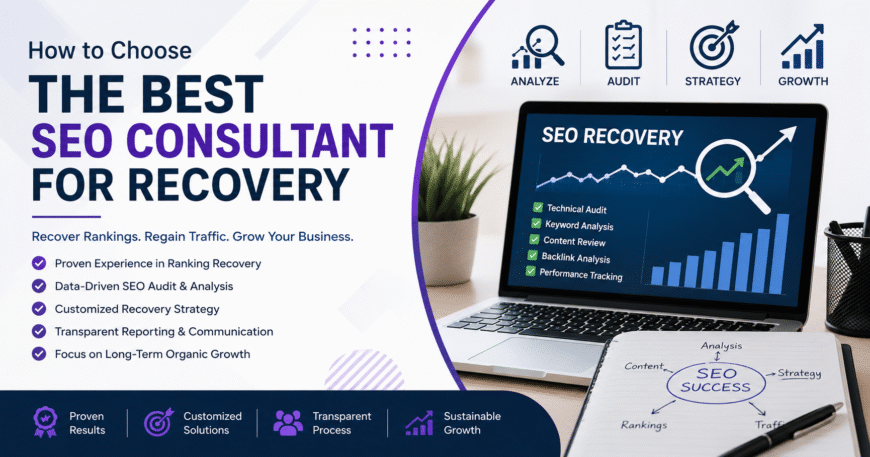
The right way to conduct recovery will include:
- Google Search Console audit
- Organic traffic audit
- Keyword rank comparison
- Technical SEO audit
- Content audit
- Competitor audit
- Backlink audit
- Indexation check
- Search intent analysis
- Website audit
In summary, the goal here is to identify what went wrong, what pages were impacted and why the site’s visibility decreased.
If an SEO consultant suggests changing everything on the site before analyzing the data, then something might be wrong with their approach.
1. Look for Experience With Ranking Drops
But not all SEO experts deal with recovery services.
Inquire from your potential consultant about their experience in:
- Ranking fluctuations due to Google algorithm update
- Decrease in organic traffic
- Quality content issues
- SEO technicalities
- Losing keyword rankings
- Issues with indexing
- Recovery
And ask them to describe their method, instead of just boasting about their past rankings.
The best consultant should know how to find the problem and improve upon it.
2. Make Sure They Analyze Google Search Console
The Google Search Console offers important data on search visibility, searches, clicks, impressions, indexation, and even individual page statistics.
In case of a ranking decrease, the consultant needs to analyze performance prior to and post-decrease.
To illustrate, they can look at:
Queries that have decreased
Pages that have lost impressions
Clicks that have decreased for the entire website or certain parts of it
Average positions
Decrease in impressions while rankings stayed relatively stable
This information can help differentiate between a real ranking issue and shifts in search demand.
3. Check Whether the Consultant Performs a Technical SEO Audit
The problem of ranking might have absolutely nothing to do with your content’s quality.
Technological issues can influence your search visibility too.
Some of the issues which an SEO specialist should examine include the following:
- Crawlability
- Indexing
- Robots.txt
- XML sitemap
- Canonical tags
- Redirects
- Broken links
- HTTPS
- Mobile optimization
- Speed
- Duplicate URLs
- Internal linking
For instance, accidental noindex commands or wrong canonical signals can result in pages not being visible for searches.
According to Google, canonicalization is responsible for determining the representative version of the pages, and canonical signals become crucial in terms of technology.
4. Evaluate Their Content Recovery Process
Content is yet another crucial element of SEO recovery.
The consultant will need to determine if your current content truly answers the search intent behind the queries.
They could consider such elements as:
- Accuracy
- Originality
- Depth
- Relevance
- Search intent
- Outdated content
- Thin content
- Duplicate content
- Irrelevant content
- Internal linking
It doesn’t mean that you need to start rewriting each article.
At times, it is better to focus on the existing pages that do have search visibility.
The advice from Google remains the same – to provide original and useful content.
5. Ask How They Analyze Competitors
Search results are competitive.
Even if there has been no change on your site, you could be losing out to better content or updated sites from your competition.
The right SEO expert will review your web pages against those of your competitors.
Some things that they can look into include:
- Content quality
- Page layout
- Keyword usage
- Search intent
- Internal links
- External links
- User experience
- Coverage of topical issues
This helps identify where your website may have fallen behind.
6. Avoid Guaranteed Ranking Promises
Watch out for consultants that claim:
“We will put you back into position #1.”
No credible SEO expert can make a commitment about a certain Google ranking.
There are a lot of factors affecting the search engine rankings, which may change in the future.
A more appropriate SEO consultant will talk about:
- What has been discovered
- What has to be done
- What actions to take
- How the result will be measured
- When a realistic deadline is expected
It is more important to work on the website and to satisfy the search users’ needs.
7. Look for a Data-Driven Recovery Strategy
A well-thought-out recovery approach would depend on data.
Recovery approaches will take the form of:
Identification → Diagnosis → Priority → Improvement → Monitoring → Testing → Refining
In cases where only blog traffic has decreased, then the recovery approach will not be the same as when there is a decrease in service page visits, homepage visibility, and branded searches.
This is the reason a custom approach works better than a one-size-fits-all approach to each site.
8. Ask How They Measure Recovery
Position in the ranking alone should not be the sole metric.
The consultant can track:
- Organic clicks
- Search impression
- CTR
- Keyword Position
- Organic Traffic
- Page-level metrics
- Leads
- Form Submission
- Phone Calls
- Organic Conversions
In the end, it’s not just about regaining the keyword position, but gaining back important organic visibility and results for your business.
9. Check Their Reporting Process
It may take time to achieve SEO recovery; therefore, reporting is essential.
An effective report should include:
Changes made
Fixes implemented
Improvements achieved
What needs more work
Future plans
It is not appropriate to provide reports with numerous keywords without providing any explanations about what those figures mean for the website.
10. Choose a Consultant Who Focuses on Long-Term SEO
Recovery should not be considered completed once ranking begins to improve.
The website should keep on working on improving the:
- Quality of the content
- Technical aspects
- Internal linking
- Topical authority
- User experience
- Search intent match
- Organic visibility
The Google Webmaster Documentation further emphasizes that a website might improve their position even after making content changes and without waiting for another core update.
This indicates that recovery is an ongoing improvement process.
Selecting the right SEO consultant for Google algorithm update recovery is not about finding the person who guarantees you that your rankings will recover the fastest.
Selecting the right SEO consultant for Google algorithm update recovery is about choosing the one who will be capable of diagnosing the issue, analyzing reliable data, identifying the impacted pages, evaluating the technical and content aspects, analyzing the competitors, and developing a quantifiable recovery plan.
Before choosing an SEO consultant, it is essential to discuss the auditing procedure, Search Console analysis, technical SEO skills, content strategy, reporting methods, and algorithm-related ranking changes management.
Above all else, it is important to choose a transparent SEO consultant.
The one who would be able to tell you why it happened, how it could happen, what should be improved, and how the progress will be quantified.

