
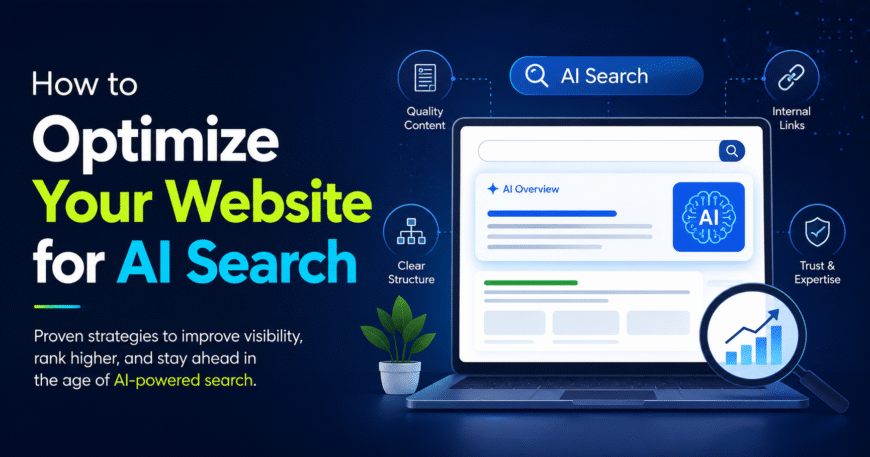
Search is evolving at an incredible rate. Google Search is now used by people to ask lengthy conversational queries and to receive direct answers, rather than using it to enter short queries and browse through the traditional blue links.
An AI-based search experience requires a shift in approach when it comes to content discovery. Businesses need to focus on classic SEO optimization along with creating credible, valuable and understandable information on their websites.
That is where AI search optimization comes into play.
It should be noted that the purpose of AI search optimization does not include manipulation of the AI engine. Instead, it aims at enhancing your website so that it could be properly understood by search engines and AI-based experiences.
1. Understand What AI Search Optimization Means
SEO by default deals with the process of getting a page visible for relevant searches.
On the contrary, AI SEO is about more than that. It is aimed at making content understandable, recognizable, connected, and shown in response to conversational queries.
Instead of looking up:
“SEO services”
users may ask:
“What can a startup do to make Google notice it?”
Your content should have an answer to both a topic and a query.
2. Create Content That Answers Real Questions
One of the most efficient methods of preparing your site for AI-driven searches is answering real-life questions of your target audience.
First, determine:
- Customer’s questions
- Problems encountered by your target audience
- Comparative questions
- How-to questions
- Questions related to prices
- Questions about your product or service
And then provide relevant answers.
Do not write content just for increasing the number of words in a particular section. Each part of your website must contain information useful to the reader.
3. Use Clear Content Structure
Structured content is better understood by the user as well as the search engine.
You should use:
- Descriptive headings
- Paragraphs that are concise
- Bullet points
- Tables when necessary
- Step-by-step instructions
- Examples
- Frequently asked questions
For instance, rather than having just one large section on website optimization, break it down into topics like technical SEO, content optimization, internal linking, page experience, and conversion optimization.
A clear structure makes important information easier to discover.
4. Match Conversational Search Intent
It is common to type a full question in an artificial intelligence-based search system, not just some keywords.
In your content, you need to have different versions of those questions which will be asked by your audience.
As for the examples, the website development firm may cover such topics as:
- How much does website development cost?
- What should be on a business website?
- How long does website development take?
- How can you make your website earn more leads?
- What makes a website SEO-friendly?
5. Demonstrate First-Hand Expertise
Trust is important for users while they choose which information to believe.
Make your content strong through the use of:
- Practical Examples
- New Ideas
- Case Studies
- Statistics
- Explanations from experts
- Actual experience
- Information about the author
Content which only reiterates information found in hundreds of other websites will probably have no added value.
Get readers to trust you.
6. Build Strong Topical Authority
A single article is not enough to build expertise on a competitive topic.
Develop related content based on your main services and link these articles internally.
For instance, a digital marketing website can develop a content cluster on SEO:
SEO -> Technical SEO -> Local SEO -> Keyword Research -> Content Optimization -> Link Building
Each article can link to other articles and service pages.
In this way, you can clearly demonstrate the connection between topics on your website.
7. Strengthen Internal Linking
Internal links help visitors find other relevant data while providing additional clues to search engines regarding your site.
When writing a new article, try to include links to:
- Service pages that are relevant to your article
- Blog posts that support your content
- Case studies
- Contact pages
- Resources
Make sure to use good anchor text rather than generic text like “click here.”
For instance, using the text technical SEO services to link to an appropriate service page is better than linking “learn more.”
8. Keep Business Information Consistent
The search engine that uses artificial intelligence must know about your company and the services offered.
Your website should contain important details that are consistent in their nature such as:
- Business name
- Services offered
- Location
- Contact details
- About
- Industry knowledge
There should be separate pages for your services rather than a single page explaining everything.
9. Use Structured Data Correctly
Structured data will help the search engine recognize various kinds of data on your website.
The types of structured data for each web page could be:
- Organization
- LocalBusiness
- Service
- Article
- Breadcrumb
- WebSite
Nevertheless, structured data must represent all the information that you see on the page.
Including schema markup doesn’t mean that your website will definitely show up in the answer provided by the artificial intelligence or get a unique feature from the search engine.
10. Keep Content Updated
Both AI-based searching and traditional searching depend on precise and relevant information.
Check for updates in:
- Stale statistics
- Obsolete examples
- Link corrections
- Services information
- Screen shots
- Industry news
- Frequently Asked Questions
Do not just change the year to update an article. Instead, make it more relevant.
11. Optimize for User Experience
Optimization for AI searches should not compromise the visitor.
Your website should be:
- Mobile responsive
- Fast loading
- Navigable
- Secure
- Accessible
- Readable
The visitor should be able to quickly know what your business is all about and what the next step is.
12. Measure Your Search Visibility
SEO Performance has to be continually monitored.
The following metrics have to be tracked through the use of the SEO tool kit which include:
- organic clicks
- impressions
- CTR
- search queries
- page performance
- conversions
- organic leads
It is also important to note the types of questions and topics that are generating impressions on your website.
AI Search Optimization is not a substitute for SEO; it represents evolution for how businesses ought to think about search visibility.
Basic elements like usefulness of content, technical accessibility, internal linking, relevance of authority, page experience, and informativeness are still important.
However, the critical difference lies in the realization that businesses need to move away from keyword-specific thinking.
What businesses should do is answer the questions posed by their customers, showcase their expertise in the matter, structure the related information, and keep improving their website.
Businesses that can create useful and trustworthy websites will find it much easier to adapt to evolving search technologies.

